



Weiss-Livnat MA in Holocaust Studies 


The Journal of Holocaust Research

WL Logo new

  • Home
  • About
  • Editorial board
  • Hebrew Volumes - דפים לחקר השואה
  • Submission of Articles
  • Past Issues
printed with permission of the Ghetto Fighters’ House Museum

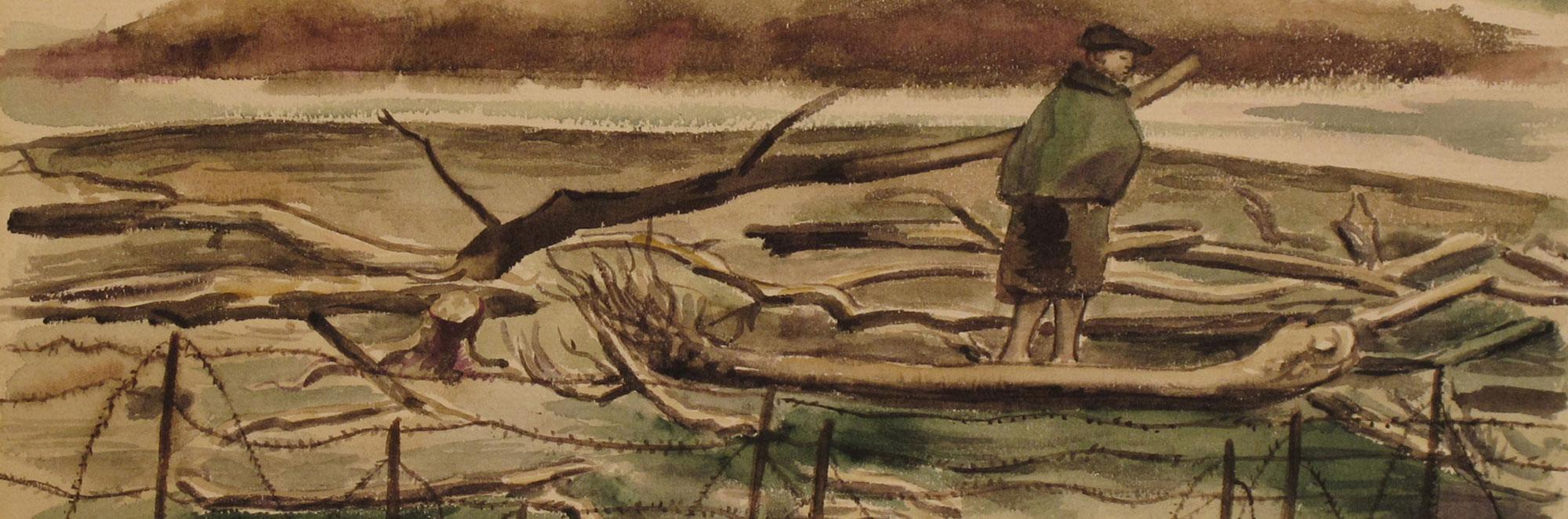
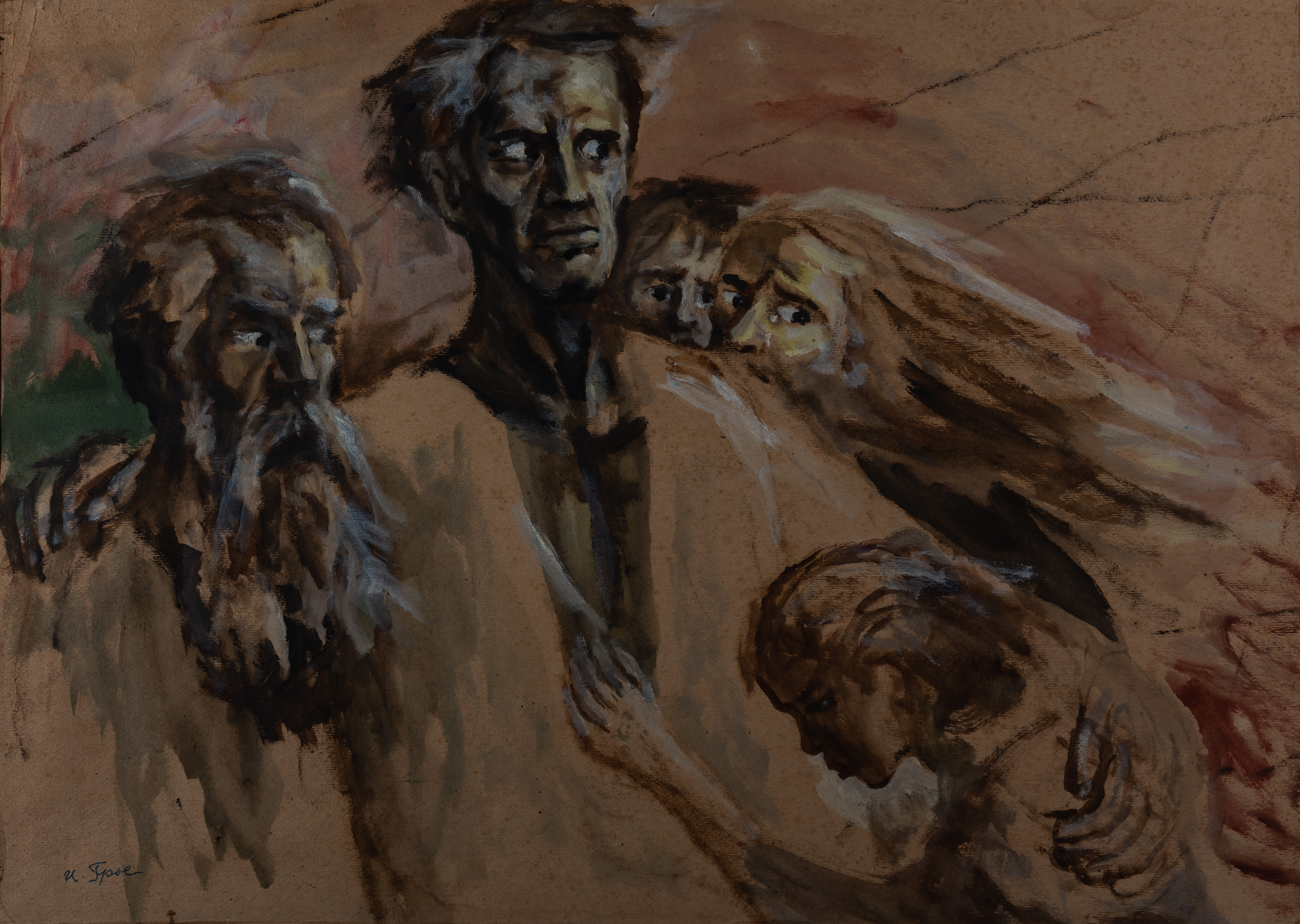
Figure on the shore by Karl Schwesig

printed with permission of the Ghetto Fighters’ House Museum

Synagogue, by an unidentified artist

printed with permission of the Ghetto Fighters’ House Museum
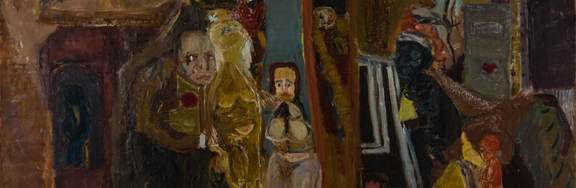
Oil painting. GFH Catalog No. 4283, courtesy of the Ghetto Fighters' House Museum

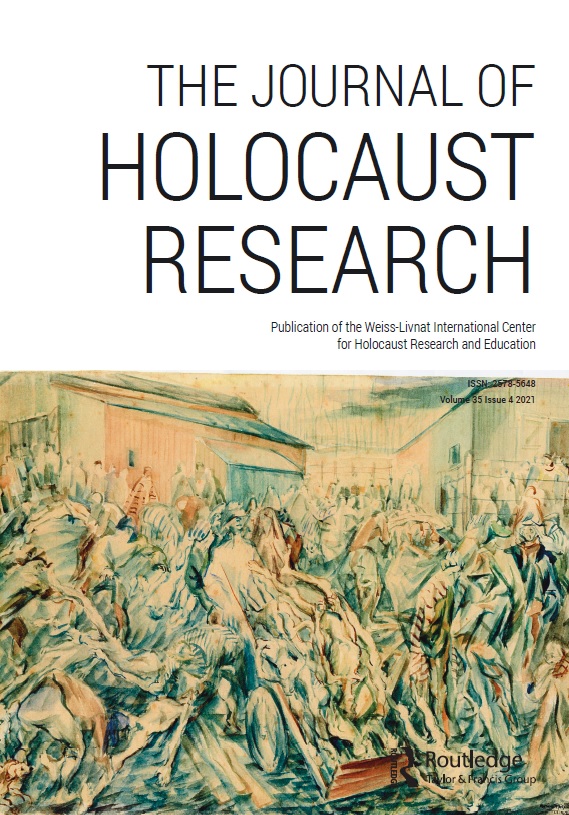
Holocaust by Leon Engelsberg (undated)

Oil painting. GFH Catalog No. 4283, courtesy of the Ghetto Fighters' House Museum
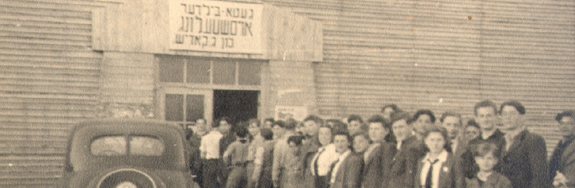
The Yiddish sign at the entry reads:

A queue in the Feldafing Displaced People Camp for George Kadish’s exhibition

The Yiddish sign at the entry reads: "Exhibition of Ghetto Photographs by G. Kadish." GFH Catalog No. 18871. Ghetto Fighters' House Museum, Photo Archive
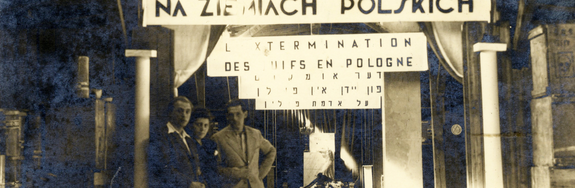
The Jewish survivor-curators posing below banners which read, in Polish, French, Yiddish and Hebrew “The Extermination of Jews in Poland.” GFH Catalog No. 38507. Ghetto Fighters' House Museum, Israel/Photo Archive

View of the central axis of the Jewish exhibition in Majdanek

The Jewish survivor-curators posing below banners which read, in Polish, French, Yiddish and Hebrew “The Extermination of Jews in Poland.” GFH Catalog No. 38507. Ghetto Fighters' House Museum, Israel/Photo Archive
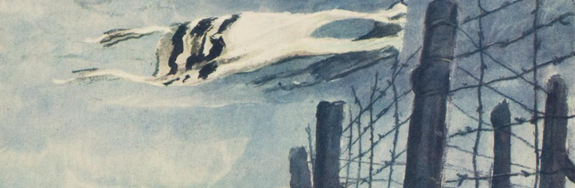
Color print on paper. From the Emanuel Ringelblum Jewish Historical Institute collection, Courtesy of Jewish Historical Institute, Warsaw, Poland.

Tallit Katan (Tałeskoten) by Zinovii Tolkachev, February 1945

Color print on paper. From the Emanuel Ringelblum Jewish Historical Institute collection, Courtesy of Jewish Historical Institute, Warsaw, Poland.
« PREVIOUS ‹ PLAYBACK STOP PLAY › NEXT »

Taylor

routledge

beit

claims

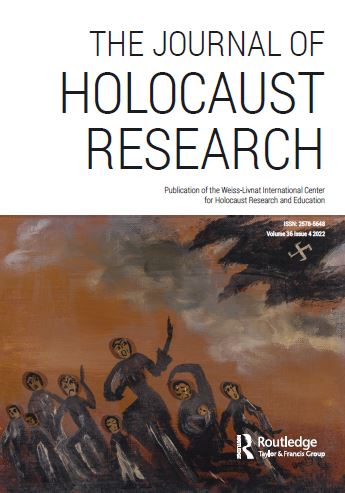
cover 36 4

The Eyewitness War Museum in the Netherlands: Spectacle, Experience, and Usurping the Witness by Laura Morowitz

Narratives of Resistance, Moral Compromise, and Perpetration: The Testimonies of Julia Brichta, Survivor of Ravensbrück by Gilly Carr

Pianos and Paintings from Transnistria: The Plunder of ‘Cultural Trophies’ During the Romanian Occupation (1941-1944) by Svetlana Suveica

A Cache of Family Letters and the Historiography of the Holocaust: Interpretive Reflections by Shirli Gilbert

Non-Jewish ‘Full Jews’: The Everyday Life of a Forgotten Group Within Nazi Germany by Harry Legg

Rachel Auerbach and the Eichmann Trial: A New Conception of Victims’ Testimonies by Leora Bilsky
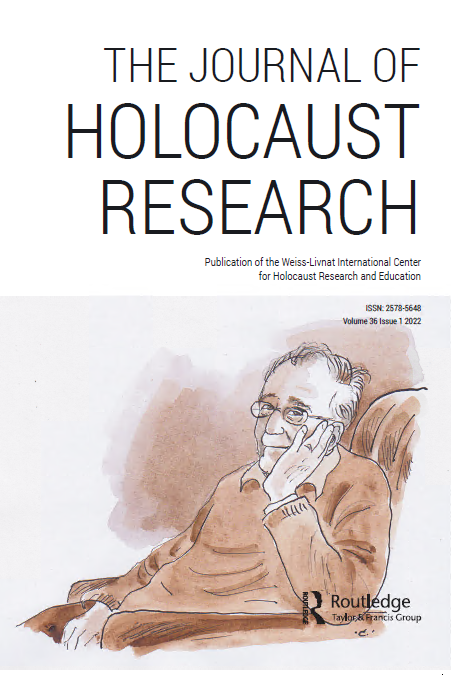
36 1 cover

Special Issue in Honor of Prof. Yehuda Bauer on His 95th Birthday

Yehuda Bauer as a teacher and mentor
Reflections on an Academic Path: The Inspiration of a Teacher and Mentor by Dalia Ofer
Looking at the Holocaust at Eye Level: Some Lessons from the Quintessential Scholar and Teacher by David Silberklang
Yehuda Bauer and the International Holocaust Remembrance Alliance (IHRA) by Dina Porat & Mark Weitzman
Theoretical accounts
Yehuda Bauer, the Concepts of Holocaust and Genocide, and the Issue of Settler Colonialism by Christopher R. Browning
A Fundamentally Singular Crime by Saul Friedländer
Are Those Who Hate Jews “Anti-Semites” or “Antisemites”? A Tribute to Yehuda Bauer by Alvin H. Rosenfeld
Conceptualizing Jewish Reactions: Between Amidah and Resistance by Havi Dreifuss
Historiographical debates
Solidarity, Hope, and Wrestling with God: The Perspective of the Will for Life of the Jewish People in Modern Times as a Major Theme in Yehuda Bauer’s Historiography by Dan Michman
Information About the Holocaust in Hungary Before the German Occupation, Revisited by Robert Rozett
Yehuda Bauer’s Assessment of the US Government and American Jewry During the Holocaust: An Analysis by Michael Berenbaum
The Life and Death of the Shtetl by Omer Bartov
Estimates of the Losses of Polish Jews in Hiding, 1942–1945: Revisiting Yehuda Bauer’s Observations by Jan Grabowski


JHR COVER

Why is the Shoah called “The Shoah” or “The Holocaust”? A history of the terminology and how it is used by Dan Michman

 The Many Faces of the Inmate as Worker in Artworks of Political Prisoners in the Buchenwald Concentration Camp by Ella Falldorf

“I searched for words”: Holocaust Survivor Poetry in Postwar Association Journals by Ellis Spicer

Reinterpreting Jewish Petitioning Practices During the Shoah: Contestation, Transnational Space, and Survival by Thomas Pegelow Kaplan

showCoverImageAnne Frank Still in the Attic: Ethics of Forgetting in Shalom Auslander’s Hope: A Tragedy by Lola Serraf

Greetings from Auschwitz: Smuggled Information about the Destruction of Slovak Jewry by Denisa Nešťáková

The Underlife of Transnistria’s Ghettos: Recategorizing and Reframing Social Interaction by Ana Bărbulescu

Multigenerational Experiences of Flight: The Case of Jewish Refugees from Galicia and Bukovina in Vienna and Lower Austria, 1918–1941 by Benjamin Grilj

Page 5 of 7

  • Start
  • «
  • 1
  • 2
  • 3
  • 4
  • 5
  • 6
  • 7
  • »
  • End

The Institute for Holocaust Research, Eshkol Tower, 22nd Floor, University of Haifa, Mount Carmel, 31905 Haifa | Tel: 972-4-8240613 | Fax: 972-4-8249010

  • Home
  • About
  • Editorial board
  • Hebrew Volumes - דפים לחקר השואה
  • Submission of Articles
  • Past Issues